Explore Lili Services Consulting Services. Need Business Help? Smart prenatal monitoring, real-time peace of mind Explore Lili Services Strategic Care, Safer Births Need Business Help? Smart prenatal monitoring, real-time peace of mind

LiliRose Tazari: Strategic Guardian of Maternal Care

LiliRose Tazari is a midwife and innovation-driven maternal health specialist who has extended her impact beyond the clinic into the world of technology and invention. By combining hands-on clinical experience in midwifery with cutting-edge knowledge and a strategic mindset, she focuses on creating solutions that enhance both maternal safety and continuous, reliable monitoring of the fetus.

She has received multiple awards at national and international invention festivals and is a proud INV member of the International Federation of Inventors’ Associations (IFIA), which highlights her position as a midwife–inventor on the global stage. One of her key achievements is contributing to the development of an innovative, modular, non-invasive maternity monitoring belt designed to track fetal movements and related maternal–fetal parameters. This smart belt aims to provide more accurate and continuous monitoring—both in clinical environments and at home—bringing greater peace of mind and confidence to mothers throughout pregnancy.

LiliVia

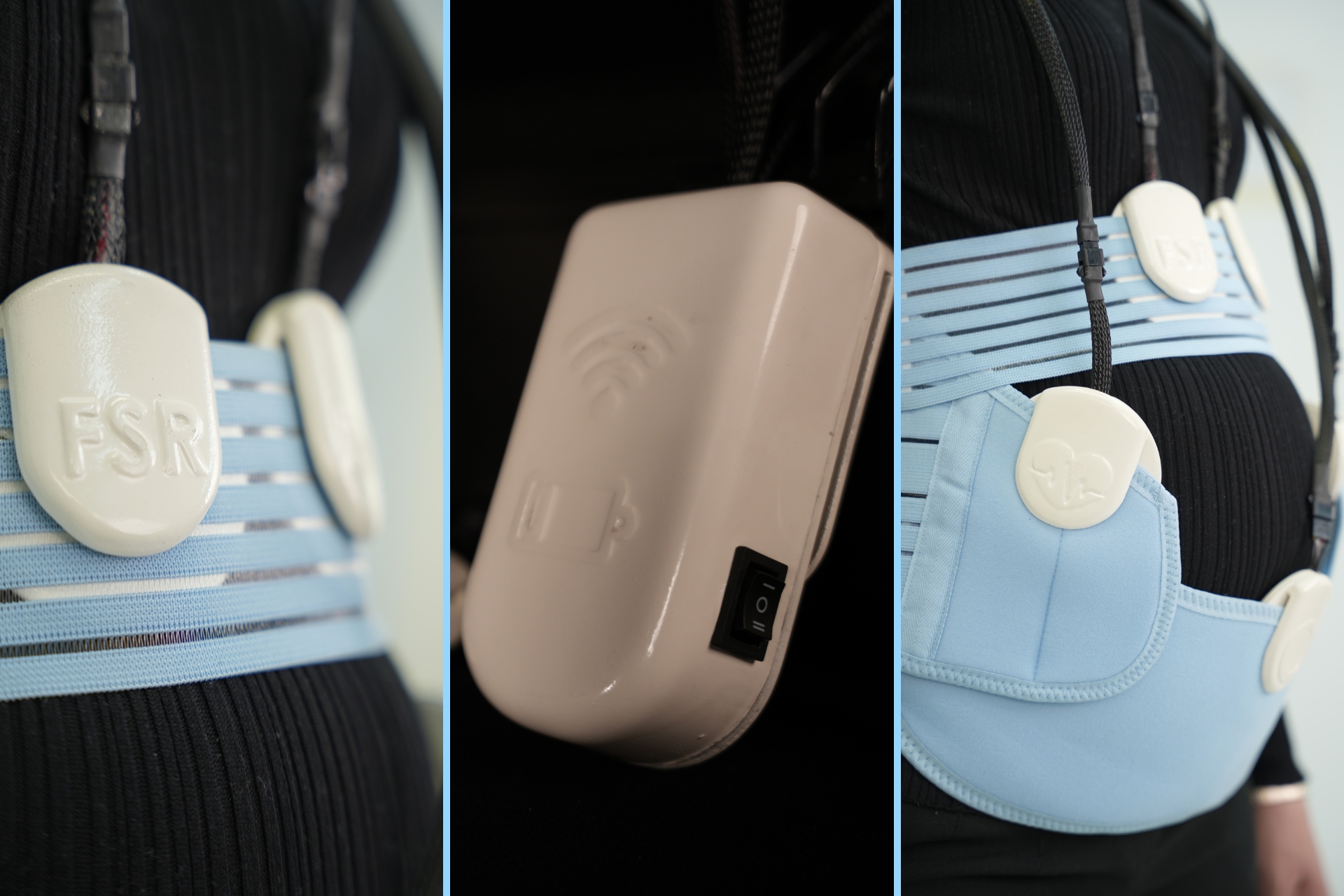
The pregnancy monitoring belt that LiliRose Tazari is working on is a modular, non-invasive belt designed to monitor fetal movements and overall fetal status. Using smart sensors, this belt can continuously record and track the baby’s movements, uterine contractions, and signals related to the fetal heartbeat without the need for invasive tools.

Core Goals Practical Advise These values give us the foundations we need. Hight Quality INNOVATION

Prototype Model for a Non-Invasive FSR-Based Pregnancy Monitoring Belt

This device is a non-invasive pregnancy monitoring belt based on FSR (Force-Sensitive Resistor) sensors, designed to capture and analyze uterine contraction patterns and fetal-related movements. The raw pressure signal from the FSRs placed on the mother’s abdomen is first passed through a smoothing/low-pass filtering stage to remove noise caused by random body movements, small shifts in position, and high-frequency artifacts, so that the main pressure trend remains. Then, a “baseline” representing the normal/resting pressure level is estimated, and this baseline is subtracted from the smoothed signal so that only meaningful contraction peaks remain; in this model, the height of each peak is interpreted as the contraction intensity.

To build a simple and clinically intuitive link between contraction intensity and fetal heart rate response, we assume that each unit increase in contraction intensity can produce an average increase of about 4 beats per minute in the fetal heart rate, with a capped maximum increase (for example, up to 8 beats per minute) to keep the system numerically and clinically stable. I have tried to express this calculation model in the simplest, most transparent way so it can be used both for preliminary numerical analysis and for early-stage presentations. At the moment, I am in the prototype development and testing phase of this belt, and I am sharing this calculation approach as an initial model for discussion and refinement.


See how LiliRose Tazari’s innovative maternity belt is transforming pregnancy monitoring.

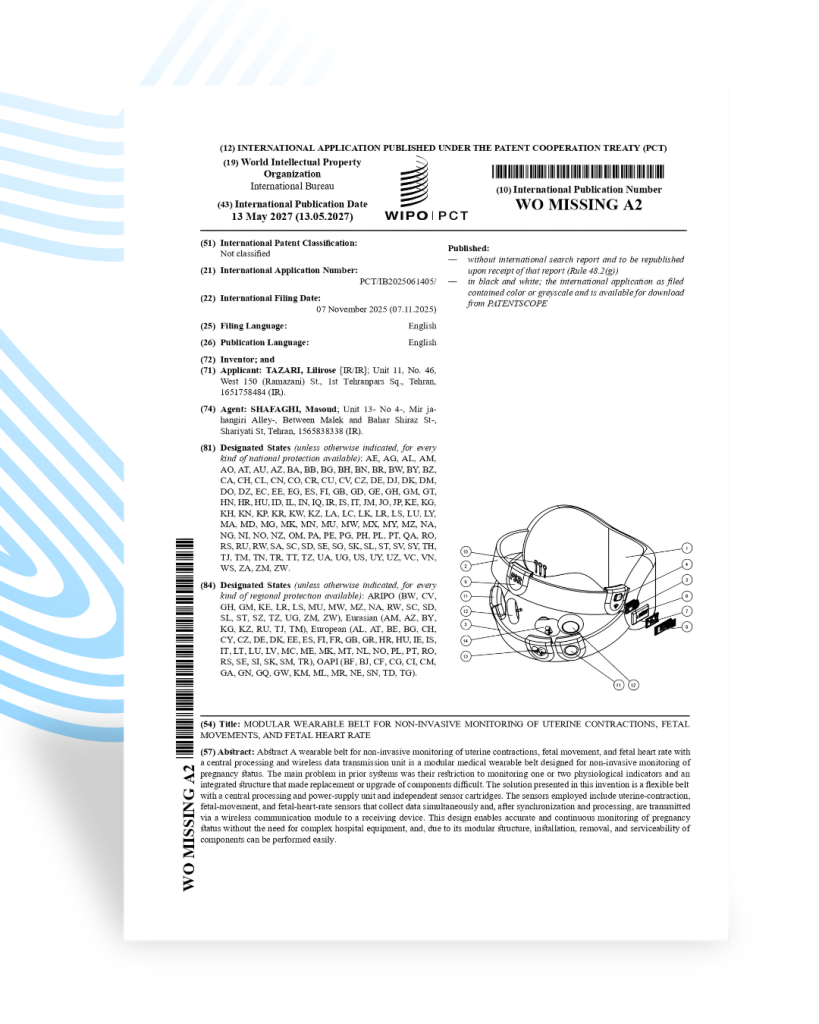
International PCT Publication for Modular Maternity Monitoring Belt

This page shows the cover of the international PCT patent application publication for the “Modular Wearable Belt for Non-Invasive Monitoring of Uterine Contractions, Fetal Movements, and Fetal Heart Rate” filed in the name of LiliRose Tazari. It displays key information such as the international application and publication numbers and dates, the name of the inventor and applicant, the representative, the designated states for patent protection, and the technical abstract of the invention. On the right side, a schematic view of the belt is presented, illustrating a flexible body, a central processing module, and independent sensor cartridges designed for continuous, non-invasive monitoring of maternal–fetal status in both clinical and home environments.

Have a question or want to collaborate? Get in touch with us below.